E-mail us: [email protected]
Tel: +86-15239857375
 English
 中文简体


 Home / Author / Shen Yiruo — Senior After-Sales Service Manager / Advanced Sintered Gears and Mechanical Structure Parts for Reliable OEM Performance
Advanced Sintered Gears and Mechanical Structure Parts for Reliable OEM Performance
 2026.10.06
 Shen Yiruo — Senior After-Sales Service Manager
Content
- 1 Understanding Sintered Gears and Mechanical Structure Parts
- 2 Why Powder Metallurgy Is Competitive
- 3 Product Advantages of Sintered Gears
- 4 Material Options for Mechanical Structure Parts
- 5 Manufacturing Process from Powder to Finished Component
- 5.1 1. Engineering Review and Design Evaluation
- 5.2 2. Powder Selection and Blending
- 5.3 3. Precision Die Filling and Compaction
- 5.4 4. Controlled High-Temperature Sintering
- 5.5 5. Sizing and Calibration
- 5.6 6. Precision Machining
- 5.7 7. Heat Treatment and Surface Enhancement
- 5.8 8. Cleaning, Inspection, and Packaging
- 6 Manufacturing Strengths and Quality Management
- 7 Performance Comparison with Alternative Manufacturing Methods
- 8 Applications in Automotive and Industrial Systems
- 9 Design Considerations for OEM Customers
- 10 Advantages of Working with an Experienced OEM Manufacturer
- 11 Common Questions and Answers
- 11.1 What are sintered gears made from?
- 11.2 Are sintered gears strong enough for automotive applications?
- 11.3 Can sintered gears be heat treated?
- 11.4 Do sintered parts need machining after pressing?
- 11.5 What is the main advantage of sintered parts over machined parts?
- 11.6 Can Welfine manufacture parts from customer drawings?
- 11.7 What information should be included in an inquiry?
- 11.8 Are sintered gears suitable for dusty or harsh environments?
- 11.9 Does powder metallurgy support custom gear shapes?
- 11.10 Can sintered gears reduce assembly cost?
- 12 Why Select These Sintered Mechanical Components
- 13 Conclusion
- 14 References
- 15 Product: Sintered Gears & Other Mechanical Structure Parts
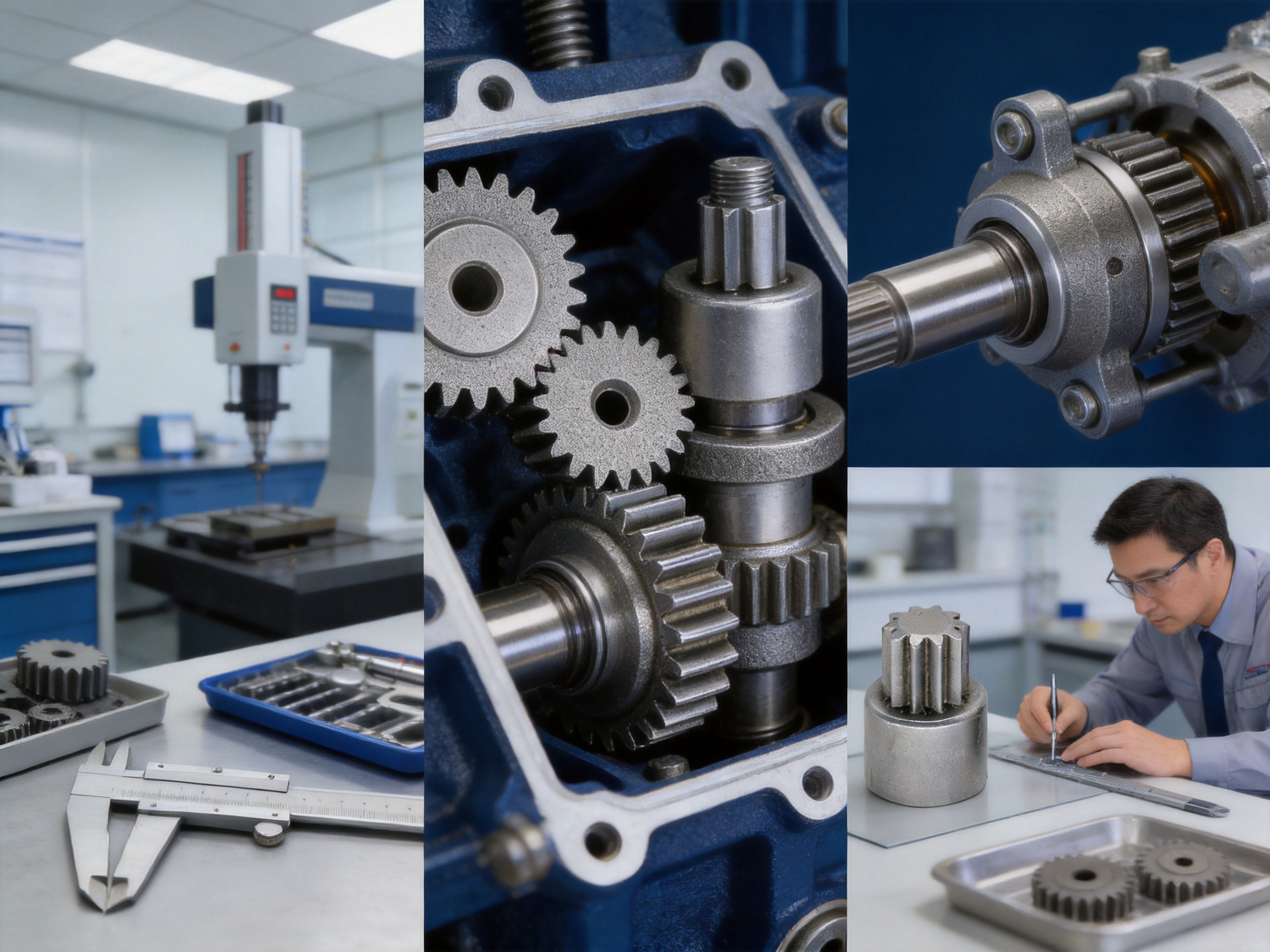
Modern mechanical systems require components that combine strength, dimensional accuracy, wear resistance, repeatable production, and competitive cost. Sintered gears and other powder metallurgy structural parts meet these requirements by transforming carefully selected metal powders into precision components through controlled compaction, sintering, sizing, machining, and finishing processes. These parts are used in automotive transmission systems, electric motors, gearboxes, power tools, home appliances, industrial automation equipment, and many other applications where dependable mechanical performance is essential.
Compared with many conventionally machined components, powder metallurgy parts can offer a more efficient manufacturing route, especially when production volumes are high and the component geometry is suitable for near-net-shape forming. Material utilization is high, production consistency is strong, and complex external profiles can often be produced with limited secondary machining. For manufacturers seeking stable supply, lower component cost, and dependable performance, sintered gears and mechanical structure parts provide a practical engineering solution.
Jiande Welfine Technology Co., Ltd. specializes in powder metallurgy sintering and related precision machining. Since its establishment in 2001, the company has developed experience in producing sintered bushings, self-lubricating bushings, gears, and various precision structural components. Its manufacturing capabilities support customized OEM and ODM requirements based on customer drawings, samples, technical specifications, and application conditions.
Understanding Sintered Gears and Mechanical Structure Parts
Sintered gears are gear components manufactured from metal powders rather than cut from solid bar stock or forged blanks. The powder is blended to achieve the required chemical composition, compressed in a precision die, and heated under controlled conditions below the material’s melting point. During sintering, the compacted particles bond together and develop the required mechanical structure.
Mechanical structure parts produced through the same technology may include hubs, cams, levers, ratchets, sprockets, pulleys, mounting components, transmission elements, and other irregularly shaped parts. These components can be designed for load transmission, positioning, actuation, support, or controlled movement.
The powder metallurgy process is particularly valuable for components with repeatable geometry and medium-to-high production volumes. A dedicated mold or die produces a consistent shape in every pressing cycle. This makes the process suitable for applications in which dimensional stability, assembly compatibility, and predictable performance are more important than one-time prototype flexibility.
Depending on the required properties, Welfine can work with iron-based, iron-copper, iron-copper-carbon, brass-based, and alloy steel powder systems. Material selection is determined by factors such as applied load, impact conditions, operating speed, wear requirements, corrosion exposure, heat treatment needs, dimensional tolerances, and the intended service life of the component.
Why Powder Metallurgy Is Competitive
Traditional machining, forging, casting, and injection molding each have important advantages. However, no single manufacturing process is ideal for every mechanical component. Powder metallurgy is competitive because it combines material flexibility, near-net-shape forming, repeatable production, and efficient use of raw material.
High Material Utilization
Machining processes remove material from a larger blank. When a gear or structural part contains a large internal opening, repeated teeth, or an irregular profile, the amount of material removed can be considerable. Powder metallurgy forms the part close to its final geometry, reducing scrap and minimizing the need for extensive cutting operations.
This efficient use of material can reduce manufacturing cost and support more sustainable production. It also allows manufacturers to use engineered powder mixtures that would be difficult or expensive to process through conventional machining.
Near-Net-Shape Production
Powder compaction can form a wide range of external and internal features directly into the part. Gear teeth, bores, steps, shoulders, grooves, and other features may be incorporated into the pressing tool. Depending on the design and tolerance requirements, only selected areas may require sizing, calibration, drilling, turning, grinding, or other finishing operations.
Near-net-shape manufacturing shortens the production route. A shorter process chain can improve delivery efficiency, reduce the number of handling stages, and limit opportunities for dimensional variation between operations.
Consistent Repetition
Once the powder composition, die design, pressing conditions, and sintering cycle have been validated, the process can produce large quantities of similar parts with a high level of repeatability. This is essential for automotive and industrial customers that need components to fit consistently in every assembly.
Production consistency also supports automated assembly. When bore dimensions, tooth profiles, outer diameters, and overall heights remain within specified tolerances, customers can reduce manual adjustment and improve line efficiency.
Flexible Material Engineering
Powder metallurgy allows manufacturers to adjust alloy composition and powder characteristics according to the intended application. Copper can improve certain aspects of strength, thermal behavior, and dimensional response. Carbon can increase hardness and support wear resistance after suitable processing. Nickel, copper, and molybdenum can contribute to the performance of alloy steel systems used in more demanding mechanical applications.
Porosity can also be managed as part of the design. While structural gears generally require adequate density and strength, controlled porosity is valuable in self-lubricating bearing materials. This illustrates the broader flexibility of powder metallurgy: the same general manufacturing technology can produce either dense load-bearing components or porous oil-impregnated bushings, depending on material selection and process control.
Product Advantages of Sintered Gears
Sintered gears are designed to transfer torque, control speed, change direction, or synchronize motion in compact mechanical systems. Their advantages are especially valuable in applications where gear size, production volume, and cost must be balanced with reliable service performance.
Strength for Everyday and Heavy-Duty Applications
Iron-based sintered materials provide a strong foundation for gears and structural parts. Fe–Cu and Fe–Cu–C compositions can offer good mechanical strength and load capacity when properly compacted and sintered. These materials are suitable for many drive mechanisms, actuator systems, household devices, and industrial assemblies.
For applications involving repeated impacts or variable loading, material density and local geometry are critical. Welfine evaluates the component design and processing route to help ensure that load-bearing areas receive suitable support. Tooth roots, hubs, keyways, shoulders, and thin sections require particular attention because stress concentration can influence service life.
Wear Resistance and Long Service Life
Gear teeth are exposed to repeated contact and sliding. Insufficient hardness, poor surface quality, contamination, or inadequate lubrication can lead to pitting, scoring, abrasive wear, or tooth deformation. Properly selected sintered materials and suitable post-processing can improve resistance to these failure modes.
Iron-copper-carbon materials can provide a balance between strength, hardness, and processability. Where higher mechanical performance is required, alloy steel powder systems and heat treatment can significantly increase strength and hardness. The final choice depends on the gear’s speed, torque, contact stress, lubrication condition, and expected duty cycle.
Dimensional Stability
Dimensional stability is essential for gears because small deviations in tooth geometry or bore size can affect backlash, noise, vibration, and load distribution. Controlled compaction and sintering help maintain predictable dimensions during mass production.
Additional sizing or calibration can be used when tighter dimensional control is required. Secondary machining may be applied to critical bores, faces, or locating surfaces. This combination of forming and precision finishing provides a practical way to balance cost with exact assembly requirements.
Compact and Lightweight Designs
Powder metallurgy can support compact gear designs with integrated features. A gear may include a hub, flange, bore, shoulder, or step without requiring multiple separate components. Integrating features can reduce assembly time, lower part count, and simplify the overall mechanism.
Reduced part count can also improve reliability. Every additional fastener, joint, or press-fit interface introduces another possible source of tolerance accumulation or loosening. A properly designed sintered structural component can combine several functions in one repeatable part.
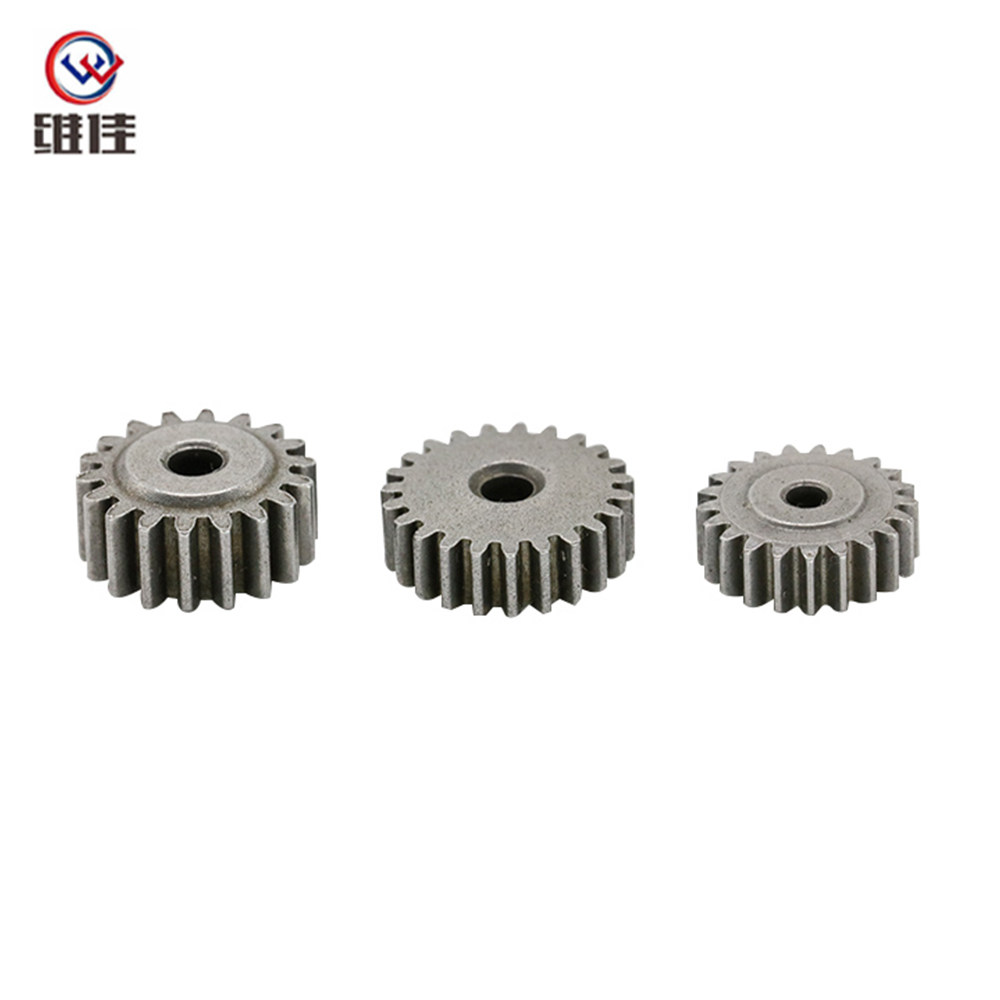
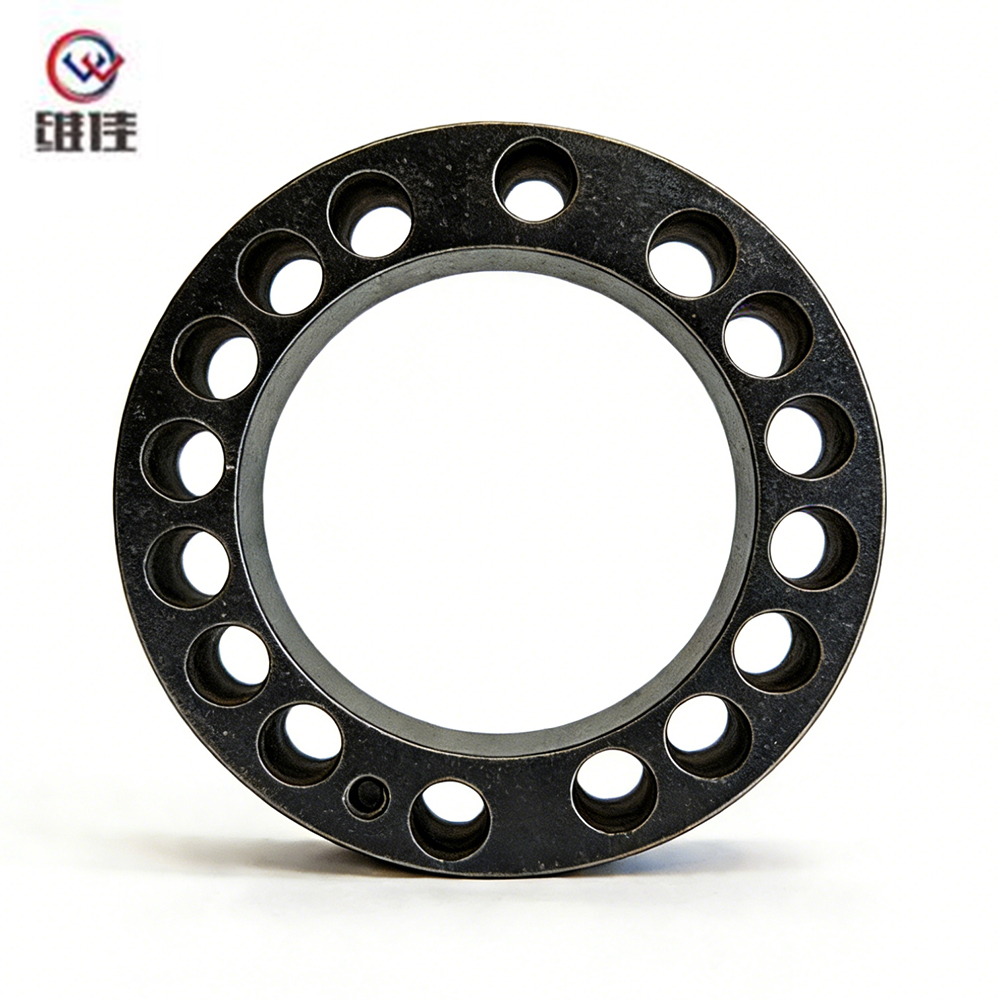
Sintered Gears & Other Mechanical Structure Parts
Material Options for Mechanical Structure Parts
Material selection is one of the most important stages in designing a sintered gear or structural part. The correct material must satisfy the mechanical and environmental requirements of the application while remaining compatible with the intended forming and finishing processes.
Fe–Cu Sintered Alloys
Iron-copper alloys are widely used for structural powder metallurgy parts. Copper can contribute to strength and improve the performance balance of the iron-based matrix. Fe–Cu materials are suitable for gears, hubs, levers, sprockets, and other components requiring general mechanical strength and stable production.
These materials are often selected when the customer needs a cost-effective solution for moderate loads and repeated operation. Final performance depends on density, composition, compaction pressure, sintering conditions, geometry, and any subsequent heat treatment.
Fe–Cu–C Sintered Alloys
The addition of carbon allows iron-based materials to achieve higher hardness and improved wear performance under appropriate processing conditions. Fe–Cu–C materials are suitable for components that experience repeated contact, friction, or moderate impact.
Carbon distribution and sintering atmosphere must be controlled carefully. Variations in carbon content can influence hardness, dimensional change, machinability, and overall performance. Consistent blending and process monitoring are therefore essential for reliable production.
Brass-Based Sintered Materials
Brass-based sintered parts offer good machinability, stable structural performance, and reliable corrosion resistance in suitable environments. They can be considered for components where appearance, ease of secondary machining, and resistance to environmental exposure are important.
Brass-based materials may be used in mechanical structure parts, small drive elements, sleeves, and other components where their combination of processability and corrosion resistance is advantageous. The precise alloy and density should be selected according to the application’s load and wear requirements.
Nickel–Copper–Molybdenum Sintered Steels
Nickel–copper–molybdenum sintered steels are intended for applications requiring higher strength and improved heat-treatment response. According to the supplied product information, these materials can achieve tensile strength of approximately 60–70 kgf/mm² in the sintered state and approximately 108–118 kgf/mm² after heat treatment, depending on the specific material, density, geometry, and processing conditions.
These performance levels may be comparable to or exceed those associated with certain carburized steels, including SNCM21, SNCM22, and SNCM23 grades, when the complete material and heat-treatment system is appropriately selected. Such materials are suitable for demanding gears and structural parts where ordinary sintered grades may not provide sufficient strength.
Manufacturing Process from Powder to Finished Component
Reliable sintered parts depend on control at every stage of production. Powder metallurgy is not simply a matter of pressing powder into a mold. Powder characteristics, blending, die filling, compaction, sintering, sizing, machining, heat treatment, cleaning, inspection, and packaging all influence final performance.
1. Engineering Review and Design Evaluation
Production begins with an assessment of the customer’s drawing, sample, three-dimensional model, or application specification. Engineers review the geometry, wall thickness, gear module, tooth profile, bore, locating surfaces, tolerances, load requirements, and proposed material.
Powder metallurgy design rules are considered at this stage. Uniform wall thickness, suitable pressing direction, adequate draft, appropriate radii, and realistic tolerance requirements can improve tool life and reduce production risks. If a feature cannot be formed effectively in the die, engineers may recommend a secondary machining operation or a modified geometry.
This early review is valuable for OEM customers because it can identify potential problems before tooling is manufactured. It also helps determine whether the part is best produced through powder metallurgy alone or through a combination of pressing and precision machining.
2. Powder Selection and Blending
Metal powders are selected according to the required material grade and performance characteristics. Particle size distribution, apparent density, flowability, compressibility, and chemical composition all affect the pressing process.
Powders are blended with alloying additions and suitable processing agents to achieve a uniform mixture. Consistent blending is important because uneven alloy distribution can lead to local variations in density, hardness, strength, or dimensional response.
Process controls are applied to maintain batch consistency. Material identification, storage conditions, mixing time, and handling procedures all contribute to stable production.
3. Precision Die Filling and Compaction
The prepared powder is fed into a precision die. The powder must fill the die cavity evenly so that the finished compact develops a uniform density distribution. Uneven filling can produce weak areas, distortion, or dimensional variation during sintering.
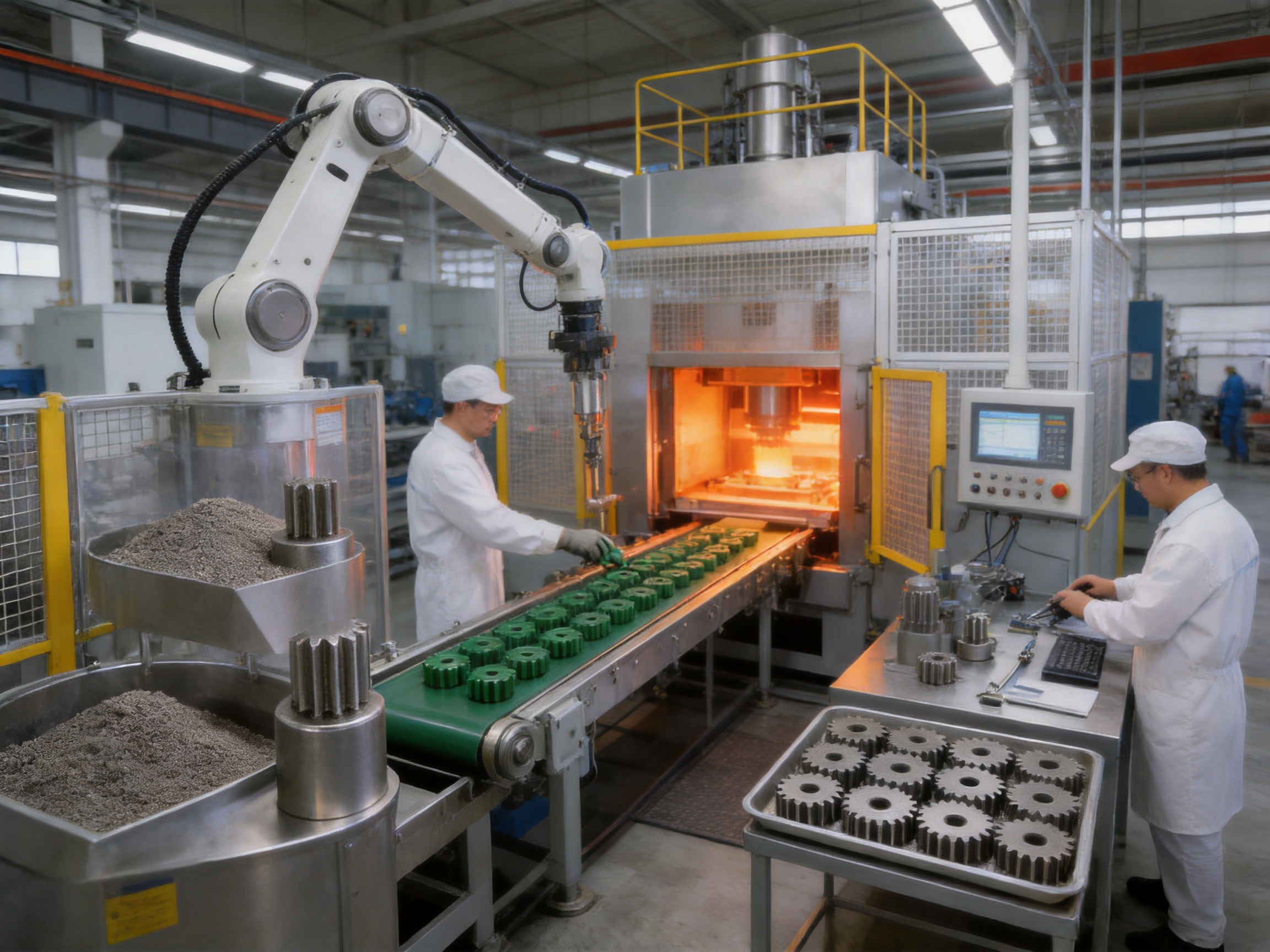
High-efficiency presses apply controlled pressure to compact the powder into a “green” part. The green part has the required general shape but does not yet possess the full mechanical strength of the final sintered component. Pressing parameters are adjusted according to material, geometry, density target, and tooling design.
For gears, the die must accurately reproduce the tooth profile and important locating features. For structural parts, the tooling may include steps, bosses, holes, grooves, and other functional details. Tool accuracy and maintenance are vital because the die directly influences the repeatability of the pressed shape.
4. Controlled High-Temperature Sintering
The compacted parts are conveyed through a high-temperature sintering furnace under a controlled atmosphere. The temperature profile is carefully managed to remove lubricants, promote particle bonding, develop the intended alloy structure, and limit oxidation.
Sintering causes the powder particles to bond and the component to gain strength. The atmosphere, heating rate, peak temperature, holding time, and cooling conditions can influence density, hardness, dimensional change, and microstructure.
Careful furnace control is particularly important for alloyed materials. Carbon-sensitive compositions and high-performance alloy steels require stable conditions to achieve consistent properties. Batch records and furnace monitoring help support traceability and repeatability.
5. Sizing and Calibration
After sintering, parts may undergo sizing or calibration. The component is placed into a sizing tool and subjected to controlled pressure to improve dimensional accuracy and geometry. Sizing can be useful for bores, outside diameters, gear tooth profiles, parallel faces, and other critical features.
This operation helps compensate for predictable sintering variation. It can also improve the fit between mating components and support smooth assembly in automated production lines.
6. Precision Machining
Although powder metallurgy can produce near-net-shape parts, some applications require additional machining. Welfine’s related precision machining capabilities can be used for critical bores, threaded features, reference faces, slots, grooves, and tight-tolerance surfaces.
Selective machining is more efficient than manufacturing the entire component from solid stock. It preserves the material-saving benefits of powder metallurgy while achieving the accuracy required at specific functional locations.
7. Heat Treatment and Surface Enhancement
Heat treatment may be applied to selected sintered steels to increase strength, hardness, wear resistance, or fatigue performance. The treatment route depends on the alloy, density, geometry, and service requirements.
Additional surface treatments may be considered when the application requires improved corrosion resistance, reduced friction, or enhanced surface durability. The suitability of a treatment must be evaluated in relation to the material’s porosity, dimensional tolerances, lubrication system, and operating environment.
8. Cleaning, Inspection, and Packaging
Finished parts are cleaned to remove residual powder, processing contaminants, and machining debris. Inspection may include dimensional measurement, visual examination, hardness testing, density evaluation, surface inspection, and other tests defined by the customer or product specification.
Packaging protects the parts from impact, contamination, and corrosion during storage and transportation. For OEM supply, packaging can also be customized to support efficient production-line feeding and identification.
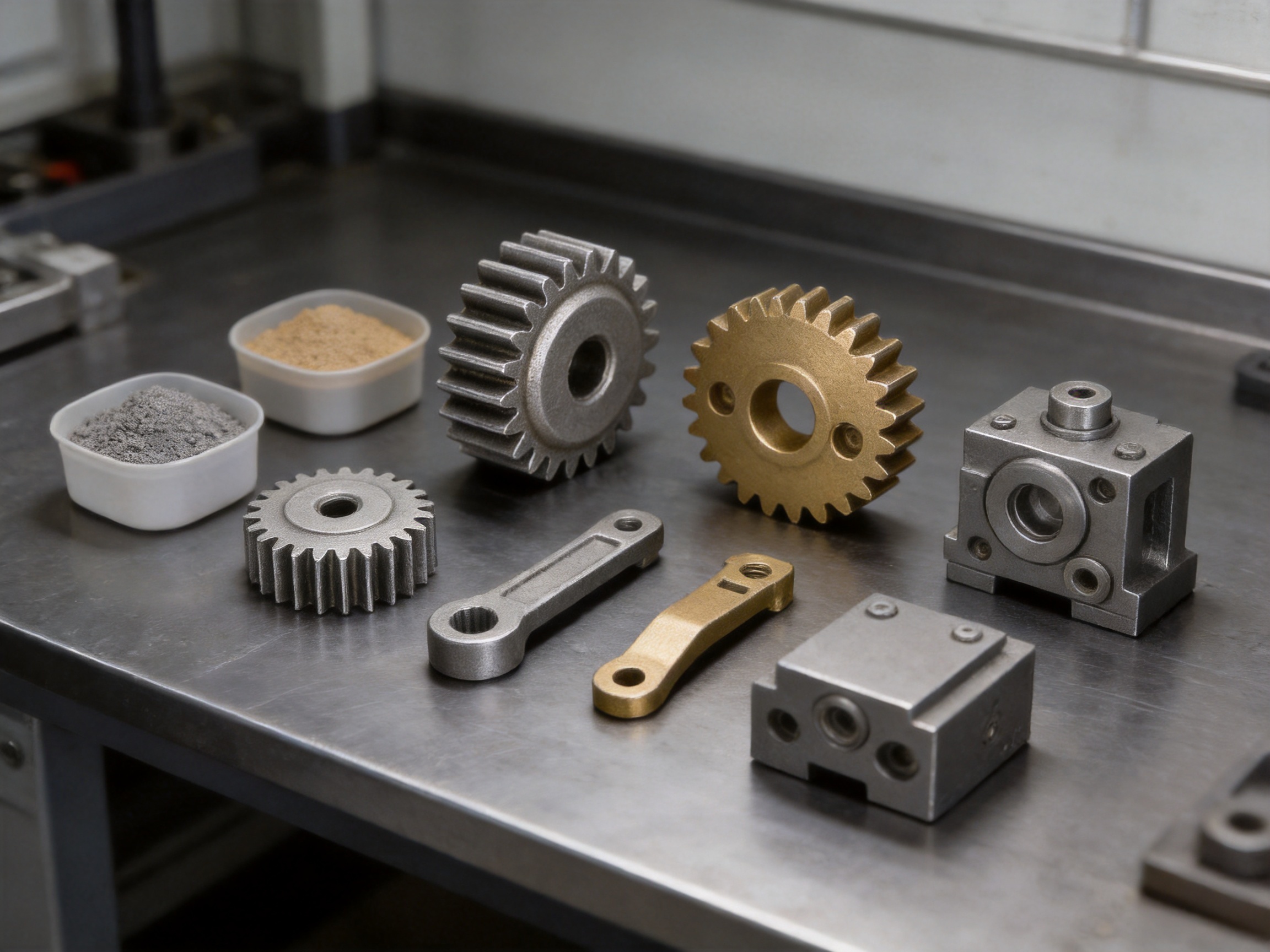
Manufacturing Strengths and Quality Management
Welfine operates a modern production base covering approximately 13,039 square meters. The facility includes high-efficiency presses, high-temperature sintering furnaces, precision forming equipment, and inspection resources required for powder metallurgy production and related machining.
More than 20 years of industry experience provide a practical foundation for process development and customer support. Experience is important in powder metallurgy because the relationship between geometry, material, density, sintering behavior, and secondary operations is complex. A design that appears simple on a drawing may require careful adjustment to produce a stable, economical part.
The company has more than 150 skilled employees supporting research and development, production, quality management, engineering, sales, and customer service. This organization enables technical information to move between departments during the product development process.
ISO 9001:2015 Quality System
ISO 9001:2015 certification indicates that the company operates a structured quality management system covering areas such as documented processes, customer requirements, production control, corrective action, and continual improvement. Certification does not replace product-specific testing, but it provides a framework for managing quality consistently.
IATF 16949:2016 Capability
IATF 16949:2016 is associated with quality management in the automotive supply chain. Its requirements emphasize risk-based thinking, process control, traceability, defect prevention, customer-specific requirements, and continual improvement. This capability is especially relevant for customers developing components for automotive transmission systems, motors, actuators, and other vehicle-related assemblies.
Automotive customers typically require stable production, documented process changes, controlled tooling, reliable traceability, and rapid response to quality concerns. A quality system aligned with automotive expectations can help support these requirements.
Process Monitoring
Quality should be built into the production process rather than verified only at the end. Powder receiving, blending, die filling, pressing force, green-part dimensions, furnace conditions, sizing, machining, and final inspection can all be monitored according to the product specification.
Process monitoring helps identify trends before they become widespread defects. For example, gradual changes in press behavior may affect green density, while furnace variation may influence hardness or dimensional response. Timely corrective action protects both product quality and production efficiency.
Performance Comparison with Alternative Manufacturing Methods
| Evaluation Factor | Sintered Powder Metallurgy Parts | Machined Parts | Forged Parts | Cast Parts |
|---|---|---|---|---|
| Material utilization | High, with near-net-shape forming | Often lower because material is removed | Generally good, although trimming may be required | Good for complex shapes, with possible runners and finishing |
| Production consistency | Strong after tooling and process validation | Strong, but dependent on machining control and tool wear | Strong for suitable high-volume designs | Dependent on mold, alloy, and casting conditions |
| Complex repeated profiles | Well suited to repeatable gear and structural profiles | Possible, but may require multiple operations | Best for suitable bulk-forming geometries | Suitable for some complex shapes, subject to casting design |
| Material flexibility | Wide range of engineered powder compositions | Wide range of solid materials | Depends on forgeability and alloy behavior | Depends on castability and defect control |
| Secondary machining | Often limited to critical features | Usually central to the process | Often required for precision surfaces | Usually required for critical dimensions |
| High-volume cost potential | Very favorable after tooling investment | Can be higher for complex repetitive parts | Favorable for suitable large-volume parts | Favorable for suitable geometries and volumes |
This comparison is not intended to suggest that powder metallurgy replaces every other process. The best manufacturing method depends on part size, production quantity, geometry, material, tolerance, load, and total system cost. Powder metallurgy becomes particularly attractive when a component has a repeatable shape, moderate dimensions, multiple formed features, and a requirement for efficient high-volume production.
Applications in Automotive and Industrial Systems
Automotive Transmission Components
Automotive transmission systems require gears and structural components that can withstand repeated motion, changing loads, vibration, and demanding production schedules. Sintered gears may be used in auxiliary mechanisms, actuators, adjustment systems, oil pump drives, and other suitable transmission-related applications.
Material and heat-treatment selection must consider torque, speed, contact stress, lubrication, temperature, and expected service life. Where the application requires higher strength, nickel–copper–molybdenum sintered steel and suitable heat treatment may be considered.
Electric Motors and Gearboxes
Electric motors and compact gearboxes often require small gears, hubs, pulleys, spacers, and structural elements with stable dimensions. Sintered components can support compact designs and efficient assembly.
Low noise and smooth operation depend on tooth accuracy, surface quality, alignment, lubrication, and appropriate backlash. Sizing, machining, and inspection can be applied to improve the fit of critical features.
Power Tools
Power tools operate under vibration, impact, and repeated load. Gears and structural parts must be compact while providing sufficient strength and wear resistance. Fe–Cu–C materials or higher-performance alloy steel systems may be considered according to the tool’s duty cycle.
Powder metallurgy can also support integrated features that reduce part count and simplify the internal transmission assembly. This is useful in drills, drivers, grinders, saws, and other compact equipment.
Home Appliances
Home appliances commonly include small motors, gearboxes, actuators, latches, adjustment systems, and drive mechanisms. These parts must be economical, consistent, and quiet during repeated operation.
Sintered structural components can be designed for high-volume production with stable dimensions. Depending on the application, brass-based materials may offer useful machinability and corrosion resistance, while iron-based materials may be selected for higher mechanical loading.
Industrial Automation Equipment
Automation equipment relies on repeatable movement and accurate positioning. Gears, cams, ratchets, guides, and other components must maintain functional dimensions over extended operating cycles.
Welfine’s OEM and ODM approach allows customers to submit drawings or samples for technical review. Engineers can then evaluate material, geometry, forming direction, tolerances, and post-processing requirements for the intended machine design.
Design Considerations for OEM Customers
Early communication between the customer and manufacturer can improve product performance and reduce total cost. The following information is useful when requesting a quotation or feasibility review.
Operating Load and Motion
Customers should provide torque, radial load, axial load, impact level, operating speed, duty cycle, and direction of rotation where applicable. A gear used intermittently at low speed may require a different material and density from a gear used continuously at high speed.
Dimensions and Tolerances
Critical dimensions should be clearly identified. These may include bore diameter, outer diameter, overall height, tooth profile, tooth thickness, runout, concentricity, flatness, and locating surfaces. Applying unnecessarily tight tolerances to every feature can increase cost without improving system performance, so functional tolerances should be prioritized.
Lubrication and Environment
Information about lubrication is important for gear design. Oil, grease, dry operation, contamination, dust, humidity, and corrosive chemicals can all influence material choice and surface treatment.
Although this product range focuses on sintered gears and structural parts, the company also produces self-lubricating sintered bushings and oil-impregnated bearings. These products use controlled porosity to retain lubricant and can complement sintered gears in mechanisms requiring low-maintenance rotation.
Assembly Method
Press fits, keyed connections, splines, pins, screws, and over-molded assemblies impose different requirements on the component. The manufacturer should understand how the part will be installed and which surfaces are used for alignment or torque transmission.
Production Quantity
Annual volume, forecast stability, batch size, and expected program life influence the economic suitability of powder metallurgy. Tooling investment is generally easier to justify when production volume is repeated and stable. Welfine can evaluate prototype, trial, and mass-production requirements as part of an OEM development program.
Advantages of Working with an Experienced OEM Manufacturer
Choosing a supplier involves more than comparing the unit price of a finished gear. Tooling capability, process knowledge, material control, inspection, communication, engineering support, and delivery reliability all influence the total value of the supplier relationship.
An experienced powder metallurgy manufacturer can help customers avoid designs that are difficult to compact or sinter. Early recommendations may include changes to wall thickness, corner radii, pressing direction, material grade, machining allowance, or tolerance allocation. These changes can improve manufacturability without compromising the function of the part.
Integrated production capabilities also reduce the need to transfer semi-finished components between multiple suppliers. When pressing, sintering, sizing, precision forming, machining, inspection, and packaging are coordinated under one manufacturing organization, communication and accountability can be improved.
Welfine provides OEM and ODM services based on customer drawings or samples. This approach is suitable for companies that need a custom gear, a replacement part, a new structural component, or an optimized version of an existing design.
Common Questions and Answers
What are sintered gears made from?
Sintered gears can be made from iron-based powder systems such as Fe–Cu and Fe–Cu–C, brass-based materials, or higher-performance nickel–copper–molybdenum sintered steels. The correct material depends on load, wear, speed, environment, tolerance, and heat-treatment requirements.
Are sintered gears strong enough for automotive applications?
Yes, sintered gears can be suitable for automotive applications when the material, density, geometry, heat treatment, and quality controls are matched to the operating requirements. Not every automotive gear is suitable for powder metallurgy, but many auxiliary drive, actuator, transmission-related, and motor components can benefit from the technology.
Can sintered gears be heat treated?
Selected sintered steel materials can be heat treated to improve strength, hardness, and wear resistance. The treatment must be chosen with consideration for the material composition, porosity, geometry, dimensional tolerance, and final application.
Do sintered parts need machining after pressing?
Many sintered parts are produced close to final shape and require little machining. However, critical bores, faces, threads, grooves, or tight-tolerance features may require sizing or precision machining. A combined process often provides the best balance between cost and accuracy.
What is the main advantage of sintered parts over machined parts?
The main advantages are efficient material utilization, near-net-shape forming, repeatable mass production, and the ability to integrate multiple features into one component. For suitable geometries and production volumes, these benefits can reduce cost while maintaining reliable performance.
Can Welfine manufacture parts from customer drawings?
Yes. Welfine provides OEM and ODM customization based on customer drawings, samples, and technical requirements. The engineering team can review the design and recommend suitable materials, tooling concepts, tolerances, and secondary operations.
What information should be included in an inquiry?
An inquiry should include the drawing or sample, material preference if known, annual quantity, critical tolerances, operating load, speed, environment, lubrication method, heat-treatment requirement, surface treatment, packaging needs, and target delivery schedule.
Are sintered gears suitable for dusty or harsh environments?
Sintered Fe–Cu and Fe–Cu–C structural parts can be designed for applications involving dust and other challenging conditions, but the complete system must be evaluated. Sealing, lubrication, surface treatment, material selection, and maintenance practices can be as important as the gear material itself.
Does powder metallurgy support custom gear shapes?
Yes. Powder metallurgy tooling can form many repeated gear profiles and structural features. The feasibility of a particular shape depends on pressing direction, wall thickness, undercuts, draft, dimensional requirements, and production quantity. Features that cannot be formed directly may be added through machining.
Can sintered gears reduce assembly cost?
They can. Powder metallurgy may allow hubs, shoulders, steps, bores, and other features to be integrated into one component. Reducing the number of separate parts can simplify assembly and reduce tolerance accumulation, provided the integrated design is suitable for the application.
Why Select These Sintered Mechanical Components
Sintered gears and structural parts offer a strong combination of engineering performance and manufacturing efficiency. Fe–Cu and Fe–Cu–C alloys provide dependable strength for many general mechanical applications. Brass-based materials offer useful machinability and corrosion resistance. Nickel–copper–molybdenum sintered steels provide a route to higher strength and heat-treated performance for more demanding components.
The manufacturing process supports near-net-shape production, high material utilization, repeatable dimensions, and integrated features. These advantages can help customers reduce waste, simplify assembly, and maintain stable quality across large production runs.
Welfine strengthens this product offering with more than two decades of powder metallurgy experience, a modern production base, skilled technical personnel, precision presses, high-temperature sintering furnaces, precision forming equipment, and quality systems certified to ISO 9001:2015 and IATF 16949:2016.
For automotive systems, power tools, electric motors, gearboxes, home appliances, and industrial automation equipment, the right sintered component can provide an effective balance of performance, cost, and production reliability. By involving the manufacturer during the design stage, OEM customers can take full advantage of powder metallurgy and develop components that are optimized for both function and manufacturability.
Conclusion
Sintered gears and other mechanical structure parts are important solutions for modern high-volume manufacturing. Through controlled powder selection, precision compaction, high-temperature sintering, sizing, machining, and inspection, these components can achieve the strength, wear resistance, dimensional stability, and consistency required by demanding mechanical systems.
The competitive value of powder metallurgy is not limited to lower material waste. It also includes the ability to form repeatable complex profiles, integrate functional features, support engineered alloy systems, and provide a scalable route from customized development to mass production.
With experience in powder metallurgy bushings, self-lubricating bearings, gears, and precision components, Jiande Welfine Technology Co., Ltd. is positioned to support global OEM and ODM customers. Its combination of technical development, manufacturing equipment, quality management, and customized service provides a practical foundation for producing reliable sintered gears and structural parts for diverse industrial applications.
References
1. ASM International, Powder Metallurgy: Processing and Materials Engineering.
2. European Powder Metallurgy Association, Powder Metallurgy Design and Manufacturing Guidance.
3. Metal Powder Industries Federation, Powder Metallurgy Materials and Applications Information.
4. ISO 9001:2015, Quality Management Systems — Requirements.
5. IATF 16949:2016, Quality Management System Requirements for Automotive Production and Relevant Service Parts Organizations.
6. Materials and performance data supplied for the sintered gears and mechanical structure parts described in this article.
Product: Sintered Gears & Other Mechanical Structure Parts

Related products
-
-
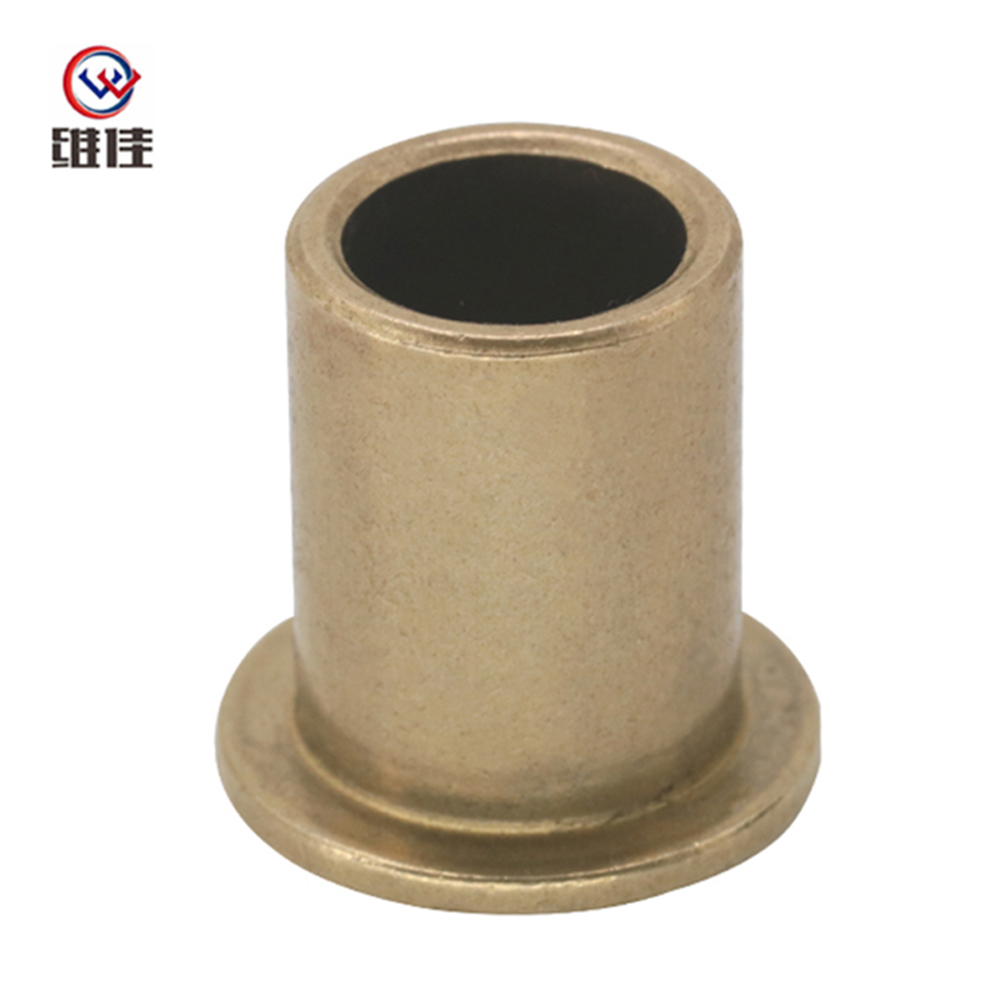
Our sintered bronze self-lubricating bearings are engineered for demanding industrial applications where traditional lubrication is impractical. Designed with advanced powder metallurgy technology, th...
See Details
Copyright © Jiande Welfine Technology Co., Ltd. All Rights Reserved. Privacy Custom Self-lubricating Sintered Bushing Manufacturers
