Soft Magnetic vs. Hard Magnetic: Where the Distinction Matters in Design
The division between soft and hard magnetic materials is not a matter of physical hardness but of coercivity — the magnetic field strength required to demagnetize a material after it has been magnetized. Soft magnetic materials have coercivity values below 1,000 A/m, meaning they magnetize and demagnetize rapidly and repeatedly with minimal energy loss per cycle. Hard magnetic materials retain their magnetization and resist demagnetization, making them suitable for permanent magnets but unsuitable for components that must switch magnetic state thousands of times per second.
For motor stators, transformer cores, and sensor flux guides, the ability to follow a rapidly alternating magnetic field without hysteresis energy loss is the defining requirement. A soft magnetic powder metallurgy component achieves this by combining high permeability — allowing strong flux concentration at low applied field — with low coercivity and low core loss (Watt per kilogram at a defined frequency and flux density). These three properties are interdependent and all degrade if the microstructure contains internal stresses, grain boundary phases, or residual porosity that impedes domain wall movement.
At Jiande Welfine Technology Co., Ltd., powder metallurgy soft magnetic materials are produced under controlled sintering atmospheres that minimize oxidation of iron particles — a critical process requirement, since iron oxide at grain boundaries reduces permeability and raises core loss even at trace concentrations.
Soft Magnetic Composite (SMC) Technology and Its Frequency Advantage
Conventional laminated silicon steel — the standard soft magnetic material in transformer cores and AC motor stators — achieves low eddy current loss by stacking thin electrical steel sheets insulated from each other. This lamination approach is effective at 50–60 Hz but becomes increasingly inefficient above a few hundred hertz because eddy current loss scales with the square of frequency, and thinner laminations become impractical to stamp and stack at sub-0.1 mm thicknesses.
Soft Magnetic Composite (SMC) materials, produced by powder metallurgy, solve the high-frequency eddy current problem through a fundamentally different architecture. Each iron powder particle is individually coated with an electrical insulation layer — typically an inorganic phosphate or polymer coating — before compaction. The result is a three-dimensional isotropic structure where eddy currents are confined within individual particles rather than allowed to circulate through the full cross-section of the core. This architecture limits effective eddy current path length to the particle diameter (typically 50–300 µm), reducing eddy current loss by one to two orders of magnitude at frequencies above 1 kHz compared to equivalent-mass laminated cores.
The frequency benefit comes with a trade-off: SMC materials have lower saturation flux density and higher hysteresis loss than optimized silicon steel at 50 Hz. The crossover frequency — above which SMC total core loss is lower than laminated steel — typically falls between 200 and 400 Hz depending on specific material grades, making SMC the preferred choice for switched reluctance motors, transverse flux motors, and high-frequency inductors operating in that range and above.
Three-Dimensional Flux Path Design: The Geometric Freedom Powder Metallurgy Enables
Laminated electrical steel constrains magnetic flux to paths that lie within the lamination plane. Any flux component perpendicular to the lamination direction encounters a high-reluctance path through the insulation layers, limiting core geometries to shapes where the magnetic circuit is essentially two-dimensional — which is why conventional AC motors use axial flux paths through cylindrical laminated stacks.
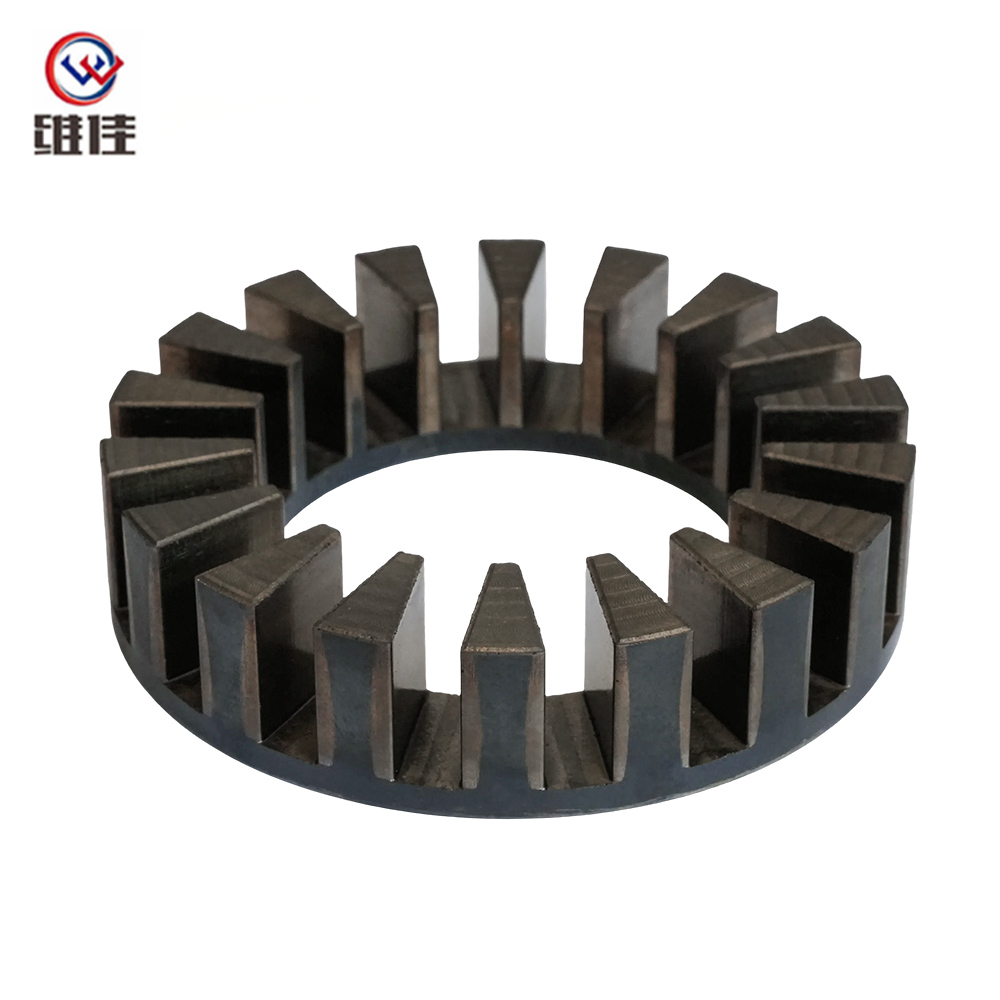
The isotropic magnetic permeability of SMC components removes this constraint entirely. Powder metallurgy soft magnetic materials can carry flux in any direction simultaneously, enabling motor topologies that are mechanically impossible with laminated steel. Claw-pole motors, transverse flux motors, and axial gap motors with complex three-dimensional pole geometries are the most commercially significant beneficiaries of this freedom, all of which require flux to flow radially, axially, and tangentially within the same core element.
The practical manufacturing implication is that near-net-shape compaction produces a complete core geometry in a single pressing operation, compared to the multi-step stamping, stacking, and bonding process required for laminated cores of equivalent complexity. For motor designers working on compact traction motors, sensor housings, or miniaturized actuators, this translates to reduced assembly steps, tighter dimensional tolerances on flux gap surfaces, and the ability to integrate mounting features and cooling channels directly into the core geometry without secondary machining. Welfine's precision machining capability provides post-sinter sizing and surface finishing where air gap tolerances require accuracy beyond what compaction alone achieves.
Key Magnetic and Physical Properties to Specify When Sourcing Sintered Soft Magnetic Parts
Engineers transitioning from laminated steel to powder metallurgy soft magnetic components need to verify a specific set of properties that differ in both measurement method and typical value range from silicon steel datasheets.
| Property |
Typical SMC Range |
Design Relevance |
| Maximum Permeability (µmax) |
200 – 500 µ₀ |
Flux concentration efficiency |
| Saturation Flux Density (Bsat) |
1.5 – 2.0 T |
Maximum flux density before core saturation |
| Coercivity (Hc) |
100 – 400 A/m |
Hysteresis loss per cycle |
| Core Loss at 1 T / 400 Hz |
15 – 50 W/kg |
Thermal management at operating frequency |
| Sintered Density |
6.8 – 7.4 g/cm³ |
Magnetic performance and mechanical strength |
| Transverse Rupture Strength |
50 – 100 MPa |
Structural integrity under assembly press-fit |
Table 1: Indicative property ranges for iron-based powder metallurgy soft magnetic composite (SMC) parts.
Beyond magnetic properties, dimensional tolerances on the air gap surface and bore are often more critical in soft magnetic cores than in structural sintered parts, since a 50 µm variation in air gap translates directly to a measurable change in inductance and flux leakage. Specifying surface finish (Ra) and perpendicularity tolerances on the gap face — not just overall dimensional tolerances — avoids performance shortfalls that only appear during electromagnetic simulation or prototype testing.
 English
 中文简体
中文简体