How Green Density and Sintering Temperature Synergistically Influence Tooth Contact Fatigue Strength and Transmission Accuracy in Powder Metallurgy Planetary Gears
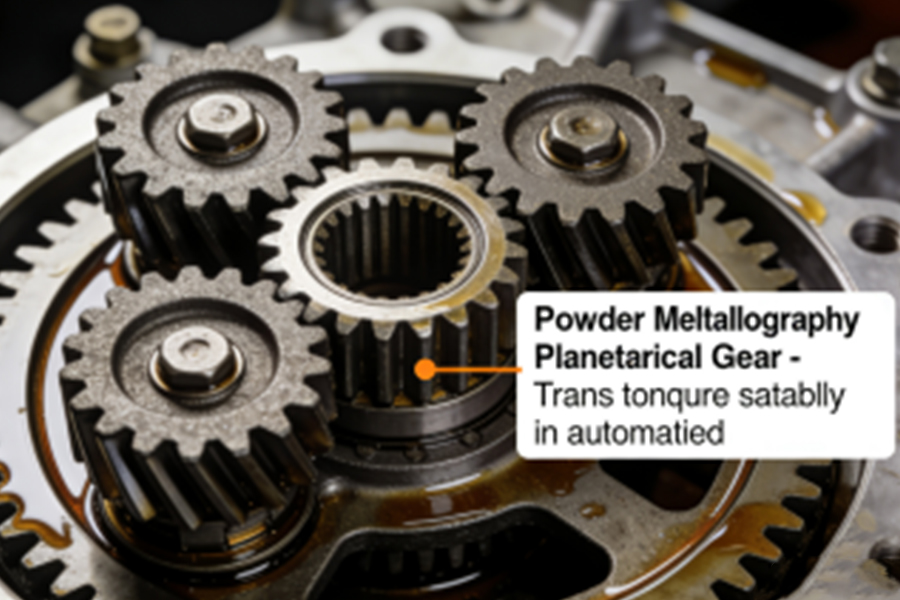
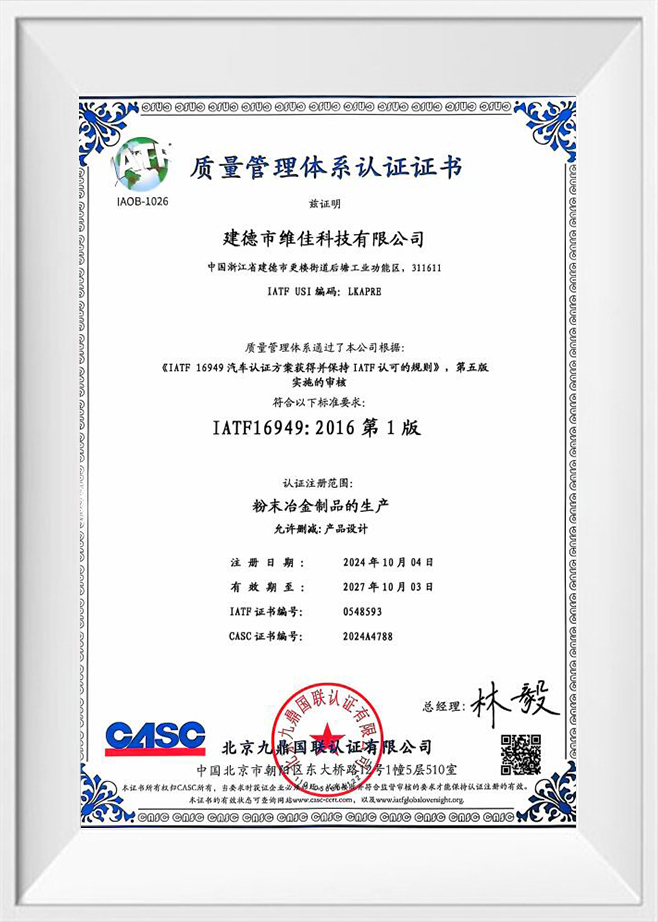
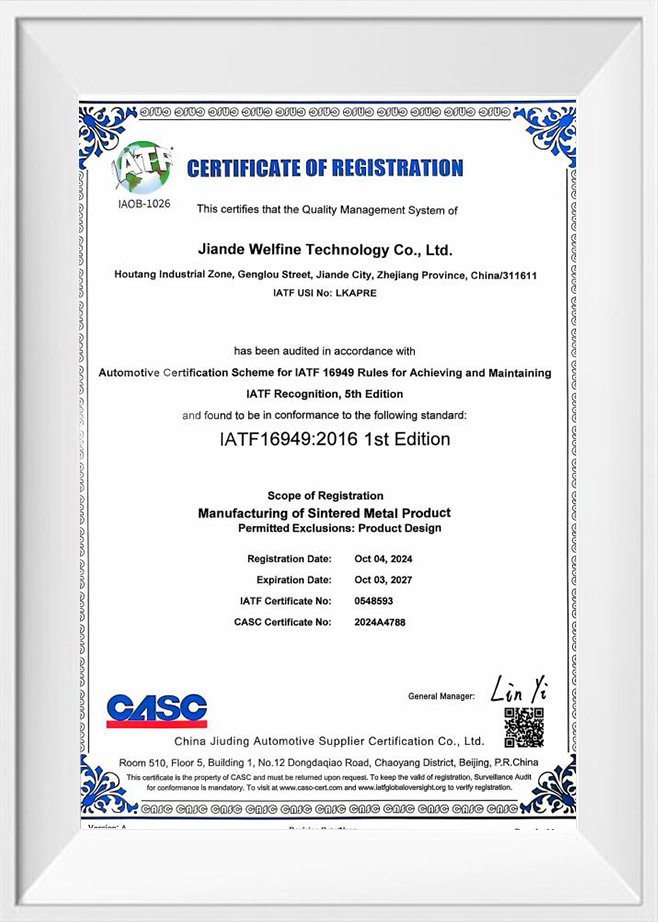
In the powder metallurgy (PM) process for planetary gears, green density (density after compaction but before sintering) and sintering temperature are two interdependent parameters that directly determine the final gear performance. Jiande Welfine Technology Co., Ltd., with over two decades of PM expertise and IATF 16949-certified processes, precisely controls these variables to achieve high fatigue strength and excellent transmission accuracy.
1. Synergistic Mechanism on Tooth Contact Fatigue Strength
- High Green Density (>7.2 g/cm³): Reduces residual porosity, creates larger inter-particle contact areas, and minimizes stress concentration sites. Under contact fatigue (pitting/spalling), higher green density allows better load distribution across the tooth flank. Jiande Welfine Technology Co., Ltd. achieves high green density through optimized powder particle size distribution and high-compaction-pressure forming.
- Optimized Sintering Temperature (1120–1250°C for iron-based alloys): Promotes complete diffusion alloying and neck growth between particles. When combined with high green density, sintering at the upper temperature range closes micro-pores and increases metallurgical bonding, dramatically improving contact fatigue limit (by 40–60% compared to low-density + low-temperature sintering).
- Detrimental Synergy: Low green density (<6.8 g/cm³) combined with low sintering temperature leaves interconnected porosity, causing early pitting under Hertzian contact stress. Over-sintering (above 1280°C) causes grain growth and distortion, reducing fatigue resistance despite high density.
2. Synergistic Mechanism on Transmission Accuracy (Gear Geometry & Dimensional Stability)
- Green Density Uniformity: Variation in green density across the gear tooth (e.g., root vs. tip) leads to differential sintering shrinkage. Jiande Welfine Technology Co., Ltd. uses precision tooling and double-press/double-sinter (DPDS) techniques to ensure density variation <0.1 g/cm³, minimizing distortion.
- Sintering Temperature Control: Higher sintering temperature increases shrinkage and improves isotropy, but requires precise atmosphere control (endothermic or N₂/H₂) to prevent oxidation. Consistent temperature (±5°C across the furnace) ensures uniform shrinkage, holding gear tooth profile errors (Fα, Fβ) within ISO 7–9 quality grade.
- Combined Effect on Backlash & Runout: Optimal synergy (green density >7.1 g/cm³ + sintering at 1180–1220°C) produces gear pitch circle runout <0.03 mm and tooth-to-tooth spacing variation <0.015 mm, suitable for precision reducers and e-drive transmissions.
3. Parameter Comparison: Effect of Green Density & Sintering Temperature on Gear Performance
| Green Density (g/cm³) |
Sintering Temp (°C) |
Contact Fatigue Strength (MPa, estimated) |
Gear Quality Grade (DIN/ISO) |
Typical Application Suitability |
| 6.6–6.8 |
1120–1150 |
280–320 |
ISO 10–11 |
Low-speed, light-load (e.g., toys, small actuators) |
| 6.9–7.1 |
1150–1180 |
350–420 |
ISO 8–9 |
Mid-range reducers, power tools |
| 7.2–7.4 |
1180–1220 |
480–550 |
ISO 7–8 |
Automotive transmissions, e-bike hub gears |
| >7.4 (with DPDS) |
1220–1250 |
580–650 |
ISO 6–7 |
Heavy-duty planetary systems, industrial robots |
For applications demanding high precision and long life, Jiande Welfine Technology Co., Ltd. recommends a minimum green density of 7.2 g/cm³ and sintering at 1180–1220°C. Explore our advanced powder metallurgy planetary gear solutions designed for superior fatigue resistance.
4. How Jiande Welfine Technology Co., Ltd. Controls Density & Sintering
- Advanced Compaction Presses: 200–800 ton CNC presses ensure consistent green density across batch production.
- Mesh Belt & Pusher Furnaces: Multi-zone controlled atmosphere sintering with ±5°C uniformity.
- In-Process Testing: Archimedes density checks, gear roll testers for transmission accuracy, and metallographic pore analysis.
- Post-Sintering Options: Steam treatment, carburizing, or carbonitriding to further enhance contact fatigue strength (up to 800 MPa case-hardened).
5. Frequently Asked Questions (FAQ)
FAQ 1: Can Jiande Welfine Technology Co., Ltd. produce powder metallurgy planetary gears that match the contact fatigue strength of wrought steel gears?
Answer: While wrought steel gears (e.g., 8620) typically achieve 700–900 MPa contact fatigue limit, Jiande Welfine Technology Co., Ltd. can reach 550–650 MPa with high-density PM (7.4 g/cm³ + DPDS) and case hardening. For many planetary gear applications (e-bikes, power tools, light automotive), this is sufficient. The company's IATF 16949-certified process ensures consistent performance. Contact our engineers to evaluate if PM planetary gears meet your specific load requirements.
FAQ 2: What green density does Jiande Welfine Technology Co., Ltd. recommend for a planetary gear requiring ISO Grade 7 transmission accuracy?
Answer: For ISO Grade 7 accuracy (tooth profile error Fα <10 µm, helix deviation Fβ <12 µm), Jiande Welfine Technology Co., Ltd. recommends a minimum green density of 7.2 g/cm³ combined with sintering at 1180–1200°C. The company uses precision compaction and double-press/single-sinter or DPDS processes to minimize distortion. Actual achievable accuracy depends on gear size (module 0.8–2.5 mm) – please provide your drawing for a tailored assessment.
FAQ 3: Does Jiande Welfine Technology Co., Ltd. offer prototyping services to validate the density-sintering synergy for custom planetary gears?
Answer: Yes. Jiande Welfine Technology Co., Ltd. provides rapid prototyping (2–4 weeks) with various density levels and sintering profiles. The company's 13,039m² facility includes tooling design, compaction, sintering, and testing labs (metallography, hardness, gear measurement). Customers receive full test reports including contact fatigue simulation data and gear inspection charts before mass production, ensuring the optimal green density and sintering temperature are selected for their specific application.
Advantages of Powder Metallurgy Gears over Forged Steel Gears in Reducing Mesh Noise and Rotor Moment of Inertia for High-Speed EV Motor Systems
In electric vehicle (EV) motor systems, especially those operating at high rotational speeds (12,000–20,000+ rpm), powder metallurgy (PM) gears offer distinct advantages over conventional forged steel gears. These benefits relate directly to noise, vibration, and harshness (NVH) reduction and to rotor system dynamics. Jiande Welfine Technology Co., Ltd., with its IATF 16949-certified PM production capabilities, engineers gears that meet the demanding acoustic and inertial requirements of modern EV powertrains.
1. Mechanism of Reduced Gear Mesh Noise (NVH Improvement)
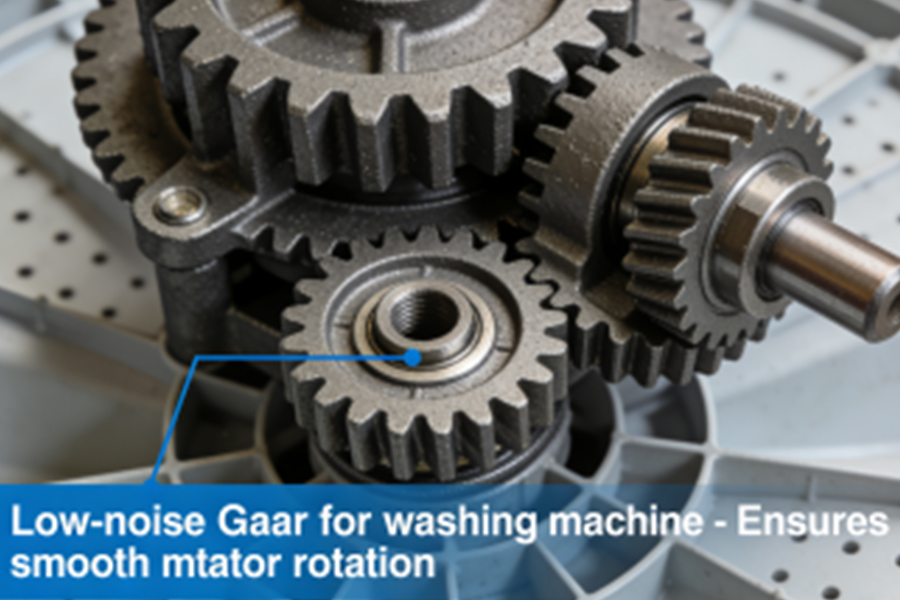
- Internal Damping of Porous Structure: PM gears typically contain 5–15% residual porosity. This micro-porosity acts as a built-in damping element, absorbing high-frequency vibration energy generated during tooth meshing. Forged steel gears have near-zero porosity, transmitting vibration directly to the housing and producing higher-pitch noise. Jiande Welfine Technology Co., Ltd. optimizes density (6.8–7.3 g/cm³) to balance strength and damping.
- Lower Mass and Improved Balance: PM gears are 5–12% lighter than equivalent forged steel gears. Lower mass reduces inertial forces during high-speed rotation, decreasing the excitation forces that cause housing vibration. This results in a 2–4 dB(A) reduction in gear whine noise, as confirmed by EV drivetrain testing.
- Controlled Runout and Profile Consistency: PM precision compaction achieves tooth-to-tooth spacing variation <0.015 mm and pitch circle runout <0.03 mm (ISO 7–8 grade). This consistency reduces transmission error, a primary source of gear whine. Forged gears, while hard, often require additional hard finishing (shaving/grinding) to achieve similar consistency, adding cost and lead time.
- Optional Steam Treatment or Coating: PM gears can be steam-treated (magnetite layer) or coated with manganese phosphate, which adds a thin, soft surface layer that further dampens micro-impact noise during initial meshing.
2. Mechanism of Reduced Rotor Moment of Inertia
- Lower Density Material: Typical PM gear density (7.0–7.3 g/cm³) is 5–8% lower than wrought steel (7.85 g/cm³). When used as a rotating component attached to the motor rotor or as an idler gear in the reduction stage, the lower mass directly reduces the polar moment of inertia (J = ∫ r² dm). A lower J allows faster rotor acceleration and deceleration, improving EV throttle response and regenerative braking efficiency.
- Thinner Cross-Sections without Sacrificing Strength: Through alloy design (e.g., Ni-Mo-Cu with carbon) and precision compaction, Jiande Welfine Technology Co., Ltd. produces PM gears with bending fatigue strength up to 350–450 MPa. This allows designers to reduce gear web thickness by 10–15% compared to forged steel, further lowering inertia without compromising durability.
- Integrated Design Capabilities: PM can combine gear teeth and lightweight features (holes, recesses, asymmetrical webs) directly in the compacted part, eliminating machining steps. Forged gears require separate drilling or milling to achieve similar weight reduction, increasing cost and cycle time.
3. Parameter Comparison: Powder Metallurgy Gear vs. Forged Steel Gear for EV High-Speed Application
| Parameter |
Forged Steel Gear (e.g., 20MnCr5) |
Powder Metallurgy Gear (optimized for EV) |
| Material Density (g/cm³) |
7.85 |
7.0–7.4 (controlled porosity) |
| Mass per unit volume (relative) |
100% (baseline) |
88–92% |
| Gear mesh noise (1m dB(A) @ 15,000 rpm, housing) |
74–78 dB(A) |
68–72 dB(A) (4–6 dB lower) |
| Polar moment of inertia (relative) |
100% |
85–90% (improved acceleration) |
| Damping ratio (internal friction, dimensionless) |
0.0005–0.001 |
0.003–0.008 (higher damping) |
| Tooth profile quality (typical as-sintered) |
Requires hard finishing (grinding) for ISO 6-7 |
ISO 7-8 achievable without hard finishing |
For EV motor systems seeking optimized NVH and rotor dynamics, Jiande Welfine Technology Co., Ltd. offers customized PM gear solutions. Explore our powder metallurgy planetary gear series – many design principles apply directly to EV motor gears.
4. Implementation by Jiande Welfine Technology Co., Ltd.
- Material Selection: High-performance pre-alloyed powders (e.g., Astaloy 85Mo, Distaloy AB) to achieve required strength at lower density.
- Compaction & Sintering: 200-800 ton CNC presses and controlled atmosphere sintering furnaces (±5°C uniformity).
- Post-Processing Options: Steam treatment (reduces noise further), precision sizing (improves runout to ISO 6), or carbonitriding (increases surface hardness for wear resistance without increasing inertia significantly).
- Validation: NVH testing on EV gear test rigs, inertia measurement via torsional pendulum, and metallographic analysis of porosity distribution.
5. Frequently Asked Questions (FAQ)
FAQ 1: Can Jiande Welfine Technology Co., Ltd. produce a PM gear for a 20,000 rpm EV motor that matches the fatigue strength of forged steel while providing lower noise and inertia?
Answer: Yes, for many EV transmission applications (e.g., e-axle idler gears, oil pump drive gears), Jiande Welfine Technology Co., Ltd. produces PM gears with bending fatigue strength of 350–450 MPa (case-hardened) – sufficient for torque loads typically seen at high speeds. The company uses high-density compaction (7.3–7.4 g/cm³) and surface densification for critical contact areas. While ultimate strength remains below forged steel, the advantages in NVH and inertia are significant. Please provide your gear specifications for a feasibility assessment.
FAQ 2: Does the porous structure of PM gears lead to corrosion issues in EV oil-cooled motor systems?
Answer: Jiande Welfine Technology Co., Ltd. addresses this by specifying closed porosity designs (≥92% density) and offering post-processing options such as steam treatment (magnetite layer) or resin impregnation. These treatments seal surface pores, preventing oil absorption and corrosion. The company's IATF 16949-certified process ensures gears withstand EV transmission fluid (ATF) exposure over 300,000 km without degradation. Standard forged gears may also corrode; PM with proper sealing performs equally well.
FAQ 3: How much rotor inertia reduction can Jiande Welfine Technology Co., Ltd. guarantee when switching from a forged steel gear to a PM gear in an EV drive motor?
Answer: Based on typical designs, Jiande Welfine Technology Co., Ltd. achieves a 10–15% reduction in polar moment of inertia for a gear of identical external geometry when using PM (density 7.1–7.3 g/cm³ vs. 7.85 g/cm³). Additional inertia reduction (another 5–10%) is possible through PM-optimized web and spoke designs that are impractical in forged steel. The company provides inertia calculation reports validated by CAD models and physical torsional testing upon request.
 English
 中文简体
中文简体